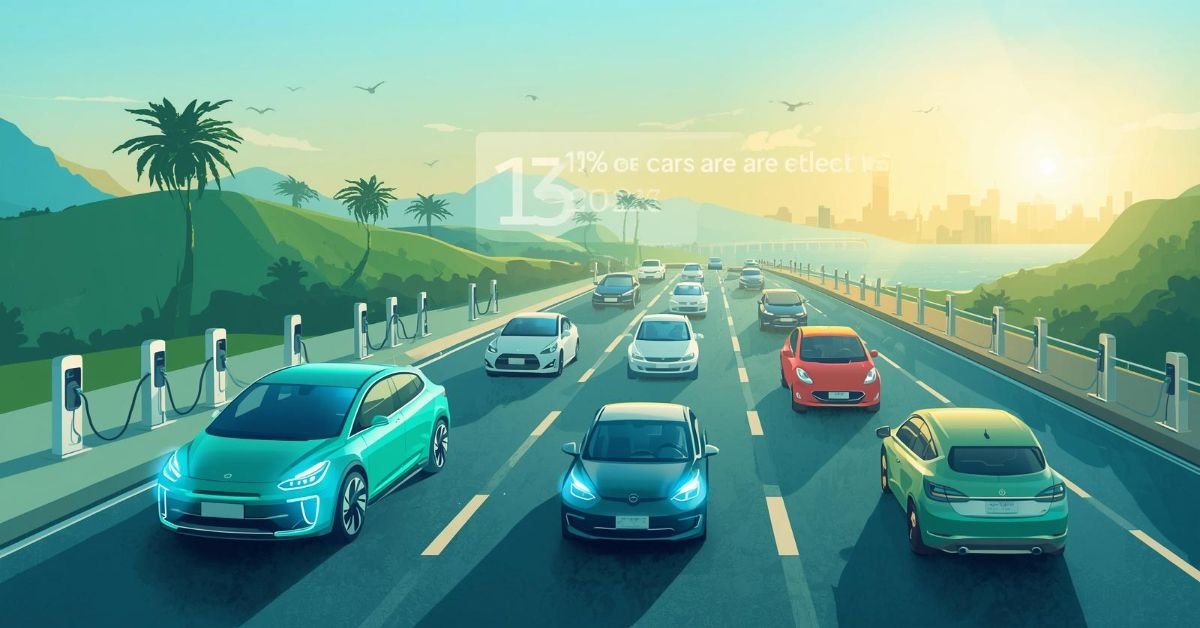
California has long been at the forefront of clean transportation in the United States. With aggressive climate policies, strong consumer incentives, and a thriving electric vehicle (EV) market, the state has become a global leader in EV adoption. But one question continues to attract attention from consumers, policymakers, and investors alike: what percentage of cars in California are electric?
Understanding the Current Percentage of Electric Cars in California
As of early 2026, electric vehicles account for approximately 13% to 15% of all registered vehicles in California. This figure includes both battery electric vehicles (BEVs) and plug-in hybrid electric vehicles (PHEVs).
While this percentage might seem modest at first glance, it represents one of the highest EV adoption rates in the world when measured across an entire vehicle fleet.
Key Data Snapshot
| Category | Estimated Value (2026) |
|---|---|
| Total registered vehicles | ~31 million |
| Total EVs (BEVs + PHEVs) | ~4.2 to 4.7 million |
| EV percentage of total fleet | 13% – 15% |
| EV share of new car sales | 30% – 35% |
Important insight: While only about 15% of all vehicles are electric, nearly one in three new cars sold in California is now electric, signaling rapid growth.
Why the Overall Percentage Is Still Growing Gradually
It’s important to understand why EVs don’t yet dominate the total vehicle population despite strong sales.
1. Long Vehicle Lifespan
Cars typically remain on the road for 10–15 years or more, meaning older gasoline vehicles still make up a large portion of the fleet.
2. Gradual Replacement Cycle
Even with strong EV sales, it takes time for new vehicles to replace older ones. This creates a lag between sales share and total fleet share.
3. Diverse Consumer Needs
Not all drivers have transitioned to EVs due to factors like:
- Charging access
- Upfront cost
- Driving range concerns in rural areas
Read more:Are EV sales declining in California
EV Growth Trends in California (2015–2026)
California’s EV growth has been exponential over the past decade.
| Year | EV Share of Total Vehicles | EV Share of New Sales |
|---|---|---|
| 2015 | ~1% | ~3% |
| 2018 | ~3% | ~8% |
| 2020 | ~5% | ~12% |
| 2022 | ~9% | ~20% |
| 2024 | ~12% | ~28% |
| 2026 | 13–15% | 30–35% |
Trend takeaway: The growth curve is accelerating, with adoption driven heavily by new vehicle purchases.
California’s Policy Push Toward Electrification
California’s EV adoption is not accidental—it’s policy-driven.
Zero-Emission Vehicle (ZEV) Mandate
The state requires automakers to sell a growing percentage of zero-emission vehicles each year.
2035 Gas Car Ban
California has announced plans to ban the sale of new gasoline-powered cars by 2035, pushing the market toward 100% electric new car sales.
Incentives and Rebates
Consumers benefit from:
- State rebates
- Federal tax credits
- Utility incentives for home charging
Regional Differences Within California
EV adoption varies significantly across regions.
High Adoption Areas
- Urban centers like Los Angeles and San Francisco
- Coastal regions with strong charging infrastructure
Lower Adoption Areas
- Rural inland regions
- Areas with limited charging stations
Regional Comparison Table
| Region Type | EV Adoption Level | Key Factors |
|---|---|---|
| Urban Coastal | High (20%+) | Charging access, higher incomes |
| Suburban | Moderate (10–15%) | Growing infrastructure |
| Rural | Low (5–8%) | Range concerns, fewer chargers |
Factors Driving EV Adoption in California
1. Environmental Awareness
California residents are more likely to prioritize sustainability and reduce carbon emissions.
2. Fuel Cost Savings
Electricity is generally cheaper than gasoline, leading to long-term savings.
3. Expanding Charging Infrastructure
California has one of the largest EV charging networks in the U.S.
4. Automaker Innovation
More EV models are available across all price segments, from affordable to luxury.
Challenges Slowing EV Adoption
Despite strong growth, several challenges remain.
Charging Infrastructure Gaps
While cities are well-equipped, rural areas still lack sufficient charging stations.
Upfront Cost
Although costs are declining, EVs can still be more expensive than traditional vehicles.
Grid Capacity Concerns
Increased EV adoption raises questions about electricity demand and grid reliability.
Read more:EV charging infrastructure grants USA
Comparison With Other States
California leads the U.S. in EV adoption by a significant margin.
| State | EV Percentage of Total Vehicles |
|---|---|
| California | 13–15% |
| Washington | ~8% |
| Oregon | ~7% |
| New York | ~6% |
| Texas | ~4% |
Key takeaway: California’s EV penetration is roughly double or triple that of most other states.
Global Comparison
California also competes with global leaders.
| Region/Country | EV Share of Total Vehicles |
|---|---|
| Norway | ~25–30% |
| California | 13–15% |
| China | ~10–12% |
| Europe (average) | ~8–10% |
California ranks among the top regions globally, especially for a large and diverse economy.
Future Projections: What Will the Percentage Be by 2030?
Experts predict significant growth over the next decade.
Projected EV Share in California
| Year | Estimated EV Percentage |
|---|---|
| 2026 | 13–15% |
| 2028 | 18–22% |
| 2030 | 25–30% |
By 2030, nearly one in three cars on California roads could be electric.
Impact on the Automotive Industry
Shift in Manufacturing
Automakers are investing heavily in EV production to meet California’s requirements.
Job Transformation
New opportunities are emerging in:
- Battery manufacturing
- Charging infrastructure
- EV maintenance
Decline of Gasoline Vehicles
Traditional internal combustion engine vehicles are gradually losing market share.
Consumer Perspective: What This Means for Drivers
Lower Operating Costs
EV owners benefit from:
- Reduced fuel costs
- Lower maintenance expenses
Improved Driving Experience
Electric cars offer:
- Instant torque
- Quiet operation
- Advanced technology features
Resale Value Trends
EV resale values are becoming more stable as demand increases.
Charging Infrastructure Growth
California continues to expand its charging network rapidly.
Types of Chargers
| Charger Type | Charging Speed | Typical Use |
|---|---|---|
| Level 1 | Slow | Home (basic) |
| Level 2 | Moderate | Home & public |
| DC Fast Charging | Very fast | Highways & commercial |
Infrastructure Outlook
The state plans to install hundreds of thousands of new chargers by 2030.
Environmental Impact of EV Adoption
Reduced Emissions
EVs significantly lower greenhouse gas emissions compared to gasoline vehicles.
Air Quality Improvements
Urban areas benefit from reduced pollution and better public health outcomes.
Renewable Energy Integration
California is increasingly powering EVs with solar and wind energy.
Expert Insights and Industry Analysis
Industry analysts agree that California’s EV adoption is a leading indicator for the rest of the United States.
Key expert observations:
- EV adoption accelerates once it crosses the 10% threshold
- Infrastructure expansion drives consumer confidence
- Policy consistency is critical for long-term growth
Common Misconceptions About EV Percentage
“EVs are already the majority”
Not yet—EVs are growing fast but still represent about 15% of the total fleet.
“Growth is slowing down”
Sales data shows continued growth, especially in new vehicle purchases.
“EV adoption is only for wealthy buyers”
Affordable EV options are increasing, expanding accessibility.
Conclusion: A Rapidly Evolving Landscape
So, what percentage of cars in California are electric? As of 2026, the answer is approximately 13% to 15%, a figure that continues to rise each year.
While EVs have not yet overtaken traditional vehicles, the momentum is undeniable. With strong policies, increasing consumer demand, and expanding infrastructure, California is on track to become one of the first regions where electric vehicles dominate the automotive landscape.
The transition to electric mobility is not just a trend—it’s a structural shift that will define the future of transportation.
1 thought on “What percentage of cars in California are electric”