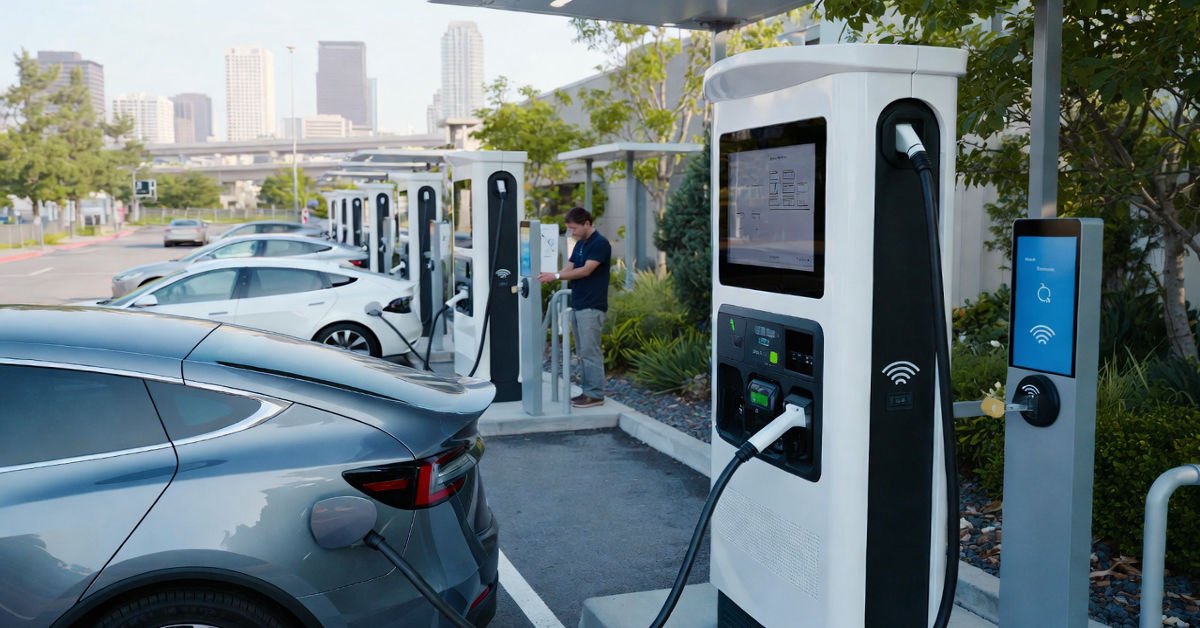
EV Charging Station Card USA revolution is accelerating across the United States. With millions of EVs now on American roads, the demand for fast, reliable, and accessible charging infrastructure has never been higher. One of the most practical tools for EV drivers is the EV charging station card—a physical or digital access card that allows users to activate and pay for charging sessions at public charging stations.
What Is an EV Charging Station Card?
An EV charging station card is an identification and payment tool used to access public EV charging networks. It can be:
-
A physical RFID card
-
A mobile app with digital wallet access
-
A universal roaming card that works across multiple networks
When a driver taps or scans the card at a charging station, the system verifies the account and begins the charging session. Charges are billed to the linked payment method or prepaid balance.
These cards remove the need for cash or manual payments and create a seamless charging experience for EV owners across the USA.
Why EV Charging Cards Matter in the USA
The USA has thousands of charging networks operated by different companies. Without a centralized payment system, EV charging cards act as the bridge between drivers and providers.
Key reasons EV charging cards are important:
-
Convenience: No need to enter payment details at every station
-
Speed: Quick tap-and-charge activation
-
Network access: One card can unlock multiple stations
-
Usage tracking: View history and energy consumption
-
Cost control: Subscription plans and discounts
For drivers traveling long distances, a charging card can be the difference between stress and smooth mobility.
How EV Charging Station Cards Work
The process is simple and user-friendly:
-
Sign up with a charging network provider
-
Link payment method (credit card or wallet)
-
Receive physical or digital card
-
Tap card at charging station
-
Charging begins automatically
-
Billing occurs after session ends
Some networks allow roaming access, meaning one card works across partner networks nationwide.
Major EV Charging Card Providers in the USA
Below is a comparison of the most popular EV charging networks and their card options:
| Network Provider | Coverage in USA | Card Type | Charging Speed | Best For |
|---|---|---|---|---|
| ChargePoint | Nationwide | RFID + App | Level 2 & DC Fast | Daily urban use |
| Electrify America | Major highways & cities | App + RFID | DC Fast | Road trips |
| EVgo | Urban centers | RFID + App | Fast charging | City drivers |
| Blink Charging | Commercial areas | RFID + App | Level 2 | Workplace charging |
| Tesla Supercharger | Tesla only | App-based | Ultra-fast | Tesla owners |
Each network has its own pricing and access model, but many now support interoperability through roaming agreements.
Types of EV Charging Station Cards
There are three main categories of EV charging cards in the USA:
1. Network-Specific Cards
These cards only work on one provider’s stations, such as ChargePoint or EVgo.
Pros:
-
Reliable performance
-
Integrated customer support
-
Loyalty rewards
Cons:
-
Limited network reach
2. Universal or Roaming Cards
These allow access to multiple networks under one account.
Pros:
-
Broader station access
-
Fewer accounts to manage
-
Ideal for travelers
Cons:
-
Slightly higher transaction fees
3. Digital Cards via Mobile Apps
Most providers now rely heavily on smartphone apps instead of physical cards.
Pros:
-
No physical card required
-
Real-time station availability
-
Remote start/stop
Cons:
-
Dependent on mobile data and battery
Cost Structure of EV Charging Station Cards in the USA
EV charging costs vary depending on network, location, and charging speed. Typical pricing models include:
| Pricing Model | Description | Average Cost |
|---|---|---|
| Per kWh | Pay for energy consumed | $0.20 – $0.60/kWh |
| Per minute | Pay by time connected | $0.15 – $0.40/min |
| Subscription | Monthly membership | $4 – $15/month |
| Idle fees | Penalty for overstaying | $0.40 – $1/min |
Some providers offer discounted rates for members using their EV charging station card regularly.
Benefits of Using an EV Charging Station Card
1. Seamless Access
Tap and start charging instantly without fumbling for payment methods.
2. Cost Transparency
Know exactly how much you are paying before charging begins.
3. Security
Encrypted systems protect user data and payment information.
4. Charging History
Track energy usage and expenses through dashboards.
5. Travel Confidence
Reliable access during road trips across multiple states.
Government Support and Infrastructure Expansion
The U.S. government supports EV infrastructure through initiatives such as the National Electric Vehicle Infrastructure (NEVI) program, which aims to build a coast-to-coast fast charging network.
This expansion will increase the importance of EV charging station cards by:
-
Standardizing access
-
Improving roaming compatibility
-
Reducing charging deserts
-
Encouraging mass adoption
Public-private partnerships are making EV charging more accessible to rural and urban drivers alike.
Challenges Facing EV Charging Cards
Despite progress, some challenges remain:
-
Fragmentation: Too many networks with different systems
-
Pricing inconsistency: Hard to compare rates
-
Technical issues: Card readers may fail
-
Availability: Stations may be occupied or offline
Solutions include roaming networks and universal payment standards.
Future of EV Charging Station Cards in the USA
The future is moving toward plug-and-charge technology, where the vehicle itself authenticates the user without a card. However, EV charging cards will remain important as backup and for non-compatible vehicles.
Expected trends:
-
Integration with vehicle dashboards
-
Biometric authentication
-
AI-based pricing optimization
-
Carbon footprint tracking
-
Nationwide roaming networks
Digital wallets and blockchain-based identity systems may also replace physical cards entirely.
How to Choose the Best EV Charging Station Card
When selecting an EV charging station card in the USA, consider:
-
Coverage in your region
-
Compatibility with your EV model
-
Transparent pricing
-
Customer service quality
-
App features and reviews
Drivers who travel frequently should prioritize roaming cards with multi-network support.
Comparison of EV Charging Card Features
| Feature | Network Cards | Roaming Cards | App-Based Access |
|---|---|---|---|
| Station Access | Limited | Wide | Depends on network |
| Ease of Use | High | High | Medium |
| Cost Control | Good | Good | Good |
| Offline Function | Yes | Yes | No |
| Best For | Local drivers | Travelers | Tech users |
Environmental Impact of EV Charging Cards
While EV charging cards themselves are small tools, their impact is significant:
-
Promote clean transportation
-
Encourage renewable energy use
-
Reduce fossil fuel dependency
-
Support emission reduction targets
Digital cards further reduce plastic waste and carbon footprint.
Security and Privacy Considerations
Modern EV charging station cards use encrypted communication to protect user data. Trusted networks comply with U.S. consumer protection laws and payment security standards.
Users should:
-
Avoid public Wi-Fi when managing accounts
-
Enable two-factor authentication
-
Monitor billing history regularly
These practices ensure safe and reliable charging experiences.
EV Charging Station Cards for Businesses and Fleets
Fleet operators and companies also benefit from EV charging cards by:
-
Monitoring employee charging behavior
-
Centralizing billing
-
Reducing fuel costs
-
Improving sustainability reports
Many providers offer enterprise-level dashboards for cost management and reporting.
Frequently Asked Questions
Are EV charging station cards mandatory?
No, but they simplify access and billing.
Can one card work nationwide?
Yes, roaming cards and major networks cover most states.
Are charging cards safe?
Yes, they use secure authentication and payment systems.
Do Tesla drivers need charging cards?
Tesla uses app-based access, but adapters allow use of other networks.
Conclusion
The EV charging station card in the USA is more than just a piece of plastic or an app feature—it is the gateway to clean, convenient, and reliable electric mobility. As EV adoption grows, these cards will continue to evolve with smarter technology, wider coverage, and better user experiences.
Pin-up Casino’s got a cool retro vibe that I’m really digging. Good collection of games, and things seem pretty smooth overall. Worth a look if you are into classic aesthetics. pin-upcasino