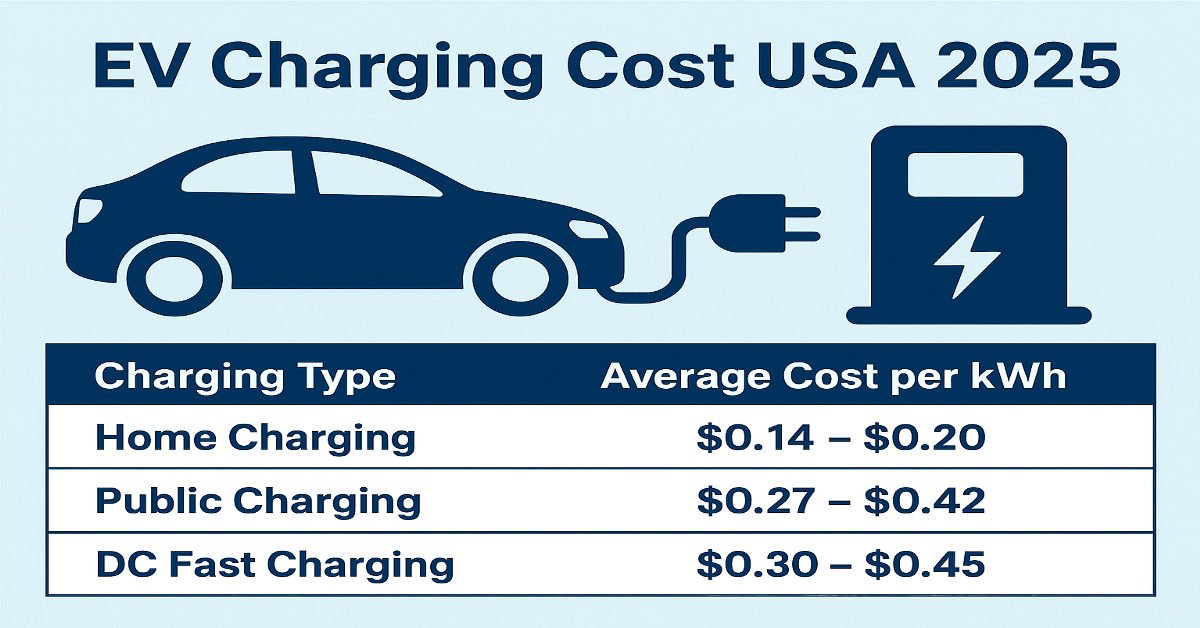
EV Charging Cost USA Comparison 2025 continue to grow rapidly in the United States, and one of the most important questions for new and existing EV owners is: “How much does EV charging cost in 2025?”
This detailed comparison guide explains home charging vs. public charging, fast-charging networks, and state-wise variations, helping EV owners make informed, cost-efficient decisions.
What Influences EV Charging Costs in the USA?
Several factors affect EV charging expenses in 2025:
-
Electricity prices by state
-
Charging level (Level 1, Level 2, DC Fast Charging)
-
Charging network provider (Tesla, Electrify America, EVgo, ChargePoint)
-
Time-of-use tariffs
-
Home vs. public charging
Average EV Charging Cost in the USA (2025)
1. Home Charging (Most Affordable Option)
Home charging uses standard electricity rates, which vary state to state.
| Charging Type | Average Cost per kWh (2025) | Approx. Cost to Charge 60 kWh Battery |
|---|---|---|
| Level 1 | $0.15 – $0.22 | $9 – $13 |
| Level 2 | $0.14 – $0.20 | $8 – $12 |
Home charging remains the cheapest and most convenient option in 2025.
2. Public Charging Cost in the USA (2025)
Public Charging Providers Comparison Table 2025
| Provider | Pricing Method | Average Cost per kWh / Minute | Notes |
|---|---|---|---|
| Tesla Supercharger | kWh-based | $0.27 – $0.35 per kWh | Non-Tesla pricing slightly higher |
| Electrify America | kWh / minute | $0.31 – $0.43 per kWh | Fastest growing DCFC network |
| EVgo | kWh / minute | $0.30 – $0.40 per kWh | Membership discounts available |
| ChargePoint | Station-owner set | $0.20 – $0.45 per kWh | Prices vary by location |
3. DC Fast Charging Cost in the USA 2025
DC Fast Charging Comparison Table
| Charging Speed | Average Price per kWh (2025) | Cost to Charge 60 kWh Battery |
|---|---|---|
| 50 kW | $0.28 – $0.35 | $17 – $21 |
| 150 kW | $0.30 – $0.40 | $18 – $24 |
| 250–350 kW | $0.32 – $0.45 | $19 – $27 |
Note: DC fast chargers are ideal for long trips but are the most expensive option.
State-Wise EV Charging Cost Comparison (2025)
Top 10 States With Lowest Home Charging Cost
| Rank | State | Avg. Cost per kWh | Cost to Charge 60 kWh |
|---|---|---|---|
| 1 | Louisiana | $0.11 | $6.6 |
| 2 | Washington | $0.12 | $7.2 |
| 3 | Idaho | $0.12 | $7.2 |
| 4 | Utah | $0.13 | $7.8 |
| 5 | Wyoming | $0.13 | $7.8 |
| 6 | Nebraska | $0.13 | $7.8 |
| 7 | Oregon | $0.14 | $8.4 |
| 8 | Kentucky | $0.14 | $8.4 |
| 9 | Montana | $0.14 | $8.4 |
| 10 | North Dakota | $0.14 | $8.4 |
What Is the Monthly Cost to Charge an EV in the USA (2025)?
Monthly Charging Cost Estimates
| EV Type | Monthly Miles | Home Charging Cost | Public Charging Cost |
|---|---|---|---|
| Compact EV | 1,000 miles | $25 – $40 | $45 – $70 |
| Mid-size EV | 1,000 miles | $30 – $45 | $50 – $80 |
| Long-range EV | 1,000 miles | $35 – $50 | $60 – $95 |
Home charging saves an average of 40–50% compared to public charging.
How EV Charging in the USA Is Expected to Change by 2026
-
More kWh-based billing standardization
-
Lower pricing due to renewable energy expansion
-
Growth of smart home charging systems
-
Tesla Supercharger network opening wider to other EV brands
Conclusion
EV charging in the USA in 2025 is becoming more transparent, accessible, and cost-efficient. While home charging remains the most affordable, public networks continue to expand nationwide, offering convenience for long-distance travel.
Understanding charging costs helps EV owners optimize their expenses and enjoy greener, cheaper transportation.
2 thoughts on “EV Charging Cost USA Comparison 2025”