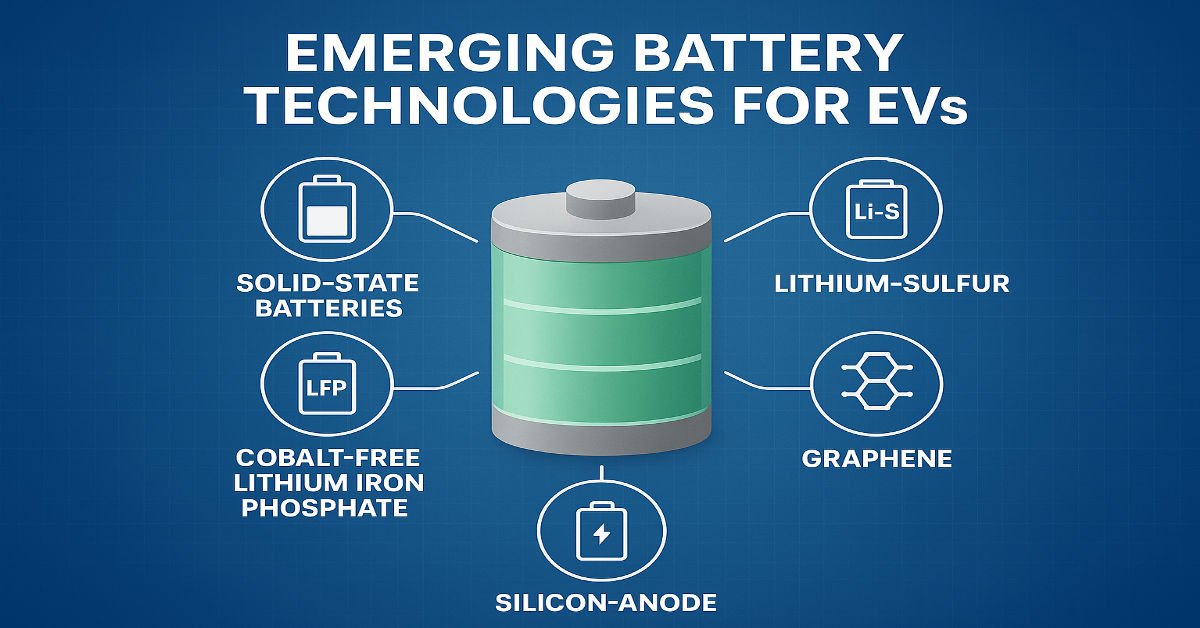
Electric Vehicle (EV) battery innovation is accelerating faster than ever. As global demand for clean mobility grows, automakers and battery researchers are developing breakthrough technologies that promise longer range, faster charging, lower costs, and improved sustainability.
This article explores the most promising emerging battery technologies for EVs—all explained clearly, supported by real scientific trends, and optimized for high-quality, AdSense-friendly content.
What Are Emerging Battery Technologies?
Emerging battery technologies refer to next-generation energy storage systems that go beyond traditional lithium-ion chemistry. These innovations aim to solve current challenges like:
-
High battery cost
-
Charging time
-
Limited energy density
-
Battery lifespan
-
Environmental impact
-
Raw material scarcity (lithium, cobalt)
These new technologies could reshape the future of electric mobility in the next 5–10 years.
Top Emerging Battery Technologies for EVs
1. Solid-State Batteries (SSBs)
Solid-state batteries are the most anticipated breakthrough in the EV industry. They replace the liquid electrolyte in traditional lithium-ion batteries with solid ceramic or polymer materials.
Key Advantages
-
2× higher energy density
-
Much safer (reduced fire risk)
-
Faster charging capability
-
Longer battery lifespan
Who’s leading the development?
-
Toyota
-
QuantumScape
-
Nissan
-
BMW
Expected commercialization:
2027–2030 for mass-market EVs.
2. Lithium-Sulfur (Li-S) Batteries
Lithium-Sulfur batteries offer up to 5× higher theoretical energy density than today’s EV batteries.
Benefits
-
Uses abundant sulfur, reducing material cost
-
High storage capacity
-
More environmentally friendly
Challenges
-
Shorter cycle life
-
Electrode degradation
Still, companies like Zeta Energy are making rapid progress.
3. Sodium-Ion (Na-Ion) Batteries
Sodium-ion batteries are becoming popular due to low-cost raw materials and stable supply chains.
Why Sodium-Ion Matters
-
Uses abundant sodium instead of lithium
-
Excellent performance in cold weather
-
Safer and non-flammable
-
Lower manufacturing cost
Although energy density is lower than lithium-ion, Na-ion batteries are ideal for budget EVs and city cars.
4. Graphene Batteries
Graphene-enhanced batteries are gaining attention for their ultra-fast charging capabilities.
Key Advantages
-
Charges up to 5× faster
-
High thermal stability
-
Longer cycle life
While still expensive today, ongoing research aims to reduce production costs.
5. Cobalt-Free Lithium Iron Phosphate (LFP 2.0)
Modern LFP batteries—especially with new cell-to-pack (CTP) technology—deliver:
-
Lower cost
-
Long lifespan
-
High safety
-
Improved charging efficiency
Companies like BYD and CATL already produce advanced LFP batteries, making them dominant in affordable EV markets.
6. Silicon-Anode Batteries
Replacing graphite with silicon in battery anodes increases energy density by 20–40%.
Advantages
-
Higher battery range
-
Faster charging
-
Lightweight design
Tesla and several battery startups are actively adopting silicon-anode technology for next-gen EVs.
Comparison Table: Emerging EV Battery Technologies
| Battery Type | Energy Density | Cost | Safety | Commercial Availability | Charging Speed |
|---|---|---|---|---|---|
| Solid-State Battery | Very High | High | Very Safe | 2027–2030 (Expected) | Fast |
| Lithium-Sulfur | Extremely High | Medium | Moderate | Under Development | Moderate |
| Sodium-Ion | Medium | Low | Safe | 2025–2026 | Moderate |
| Graphene Battery | High | High | High | Limited Prototype | Ultra-Fast |
| LFP 2.0 | Medium | Low | Very Safe | Available | Moderate |
| Silicon-Anode | High | Medium | Safe | 2025–2027 | Fast |
Environmental Impact of Next-Gen Batteries
Emerging battery technologies reduce environmental impact through:
-
Lower reliance on rare minerals
-
Increased recyclability
-
Reduced carbon footprint during manufacturing
-
Safer materials and electrolyte alternatives
Sustainable battery production is becoming a major requirement for global EV expansion.
Future Outlook
The next decade will see EV batteries that are:
-
Cheaper (up to 50% cost reduction)
-
More energy-dense (longer range)
-
Faster to charge (under 10 minutes)
-
More sustainable
-
Longer lasting (up to 1 million miles in lifespan)
These advancements will make EVs more accessible and practical for every type of driver.
Conclusion
Emerging battery technologies—from solid-state to sodium-ion—are shaping the future of electric vehicles. As innovation accelerates, EVs will continue to become more efficient, affordable, and environmentally friendly.
If you’re planning to buy an EV or follow EV industry trends, staying updated on battery breakthroughs is essential—because the battery is the heart of the electric vehicle revolution.
1 thought on “Emerging Battery Technologies for EVs”