Introduction
Electric Cars Available in Australia once a late adopter of EV technology, is now catching up rapidly — thanks to government incentives, expanding charging networks, and increased consumer awareness. From affordable compact EVs to luxury electric SUVs, the choices in 2025 are broader, smarter, and more efficient.
Australia’s Growing Electric Vehicle Market in 2025
Australia’s EV market has witnessed unprecedented growth since 2023, with EV sales surpassing 10% of all new car registrations. Major automakers are prioritizing Australia as a key market due to its rapidly expanding charging infrastructure and green energy commitments.
Key Factors Driving EV Adoption in Australia
| Factor | Description |
|---|---|
| Government Incentives | State-level rebates and tax reductions on new EV purchases. |
| Infrastructure Growth | Over 3,000 public fast-charging stations nationwide by 2025. |
| Rising Fuel Prices | EVs offer a sustainable and cost-efficient alternative. |
| Corporate Fleet Electrification | Businesses shifting to EV fleets for sustainability goals. |
Expert Insight:
According to the Electric Vehicle Council of Australia, by the end of 2025, over 40 electric vehicle models will be available, covering all price segments.
Top Electric Cars Available in Australia in 2025
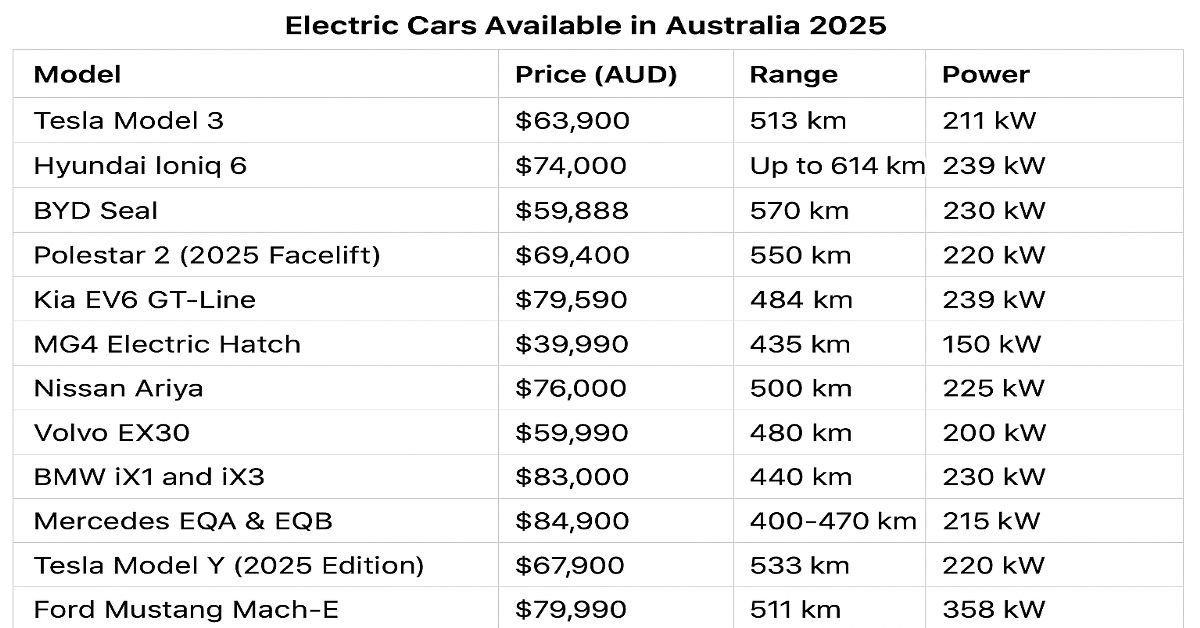
Below is a detailed list of the most popular electric cars available in 2025, categorized by price segment and performance.
🚗 1. Tesla Model 3 (2025 Edition)
-
Price (AUD): From $63,900
-
Range: 513 km (WLTP)
-
Charging Time: 25 minutes (Supercharger)
-
Power: 211 kW
-
Top Speed: 225 km/h
Why it’s popular:
The Model 3 remains the benchmark for mid-range electric sedans in Australia. With cutting-edge Autopilot technology and access to Tesla’s exclusive Supercharger network, it’s a favorite among both professionals and eco-conscious drivers.
🚙 2. Hyundai Ioniq 6
-
Price (AUD): From $74,000
-
Range: Up to 614 km
-
Charging: 10–80% in 18 minutes (350 kW fast charger)
-
Power: 239 kW
Highlights:
Sleek, futuristic, and aerodynamic, the Ioniq 6 is Hyundai’s flagship EV sedan. It’s known for its ultra-fast charging capability, eco-friendly interiors, and class-leading efficiency.
🚘 3. BYD Seal
-
Price (AUD): From $59,888
-
Range: 570 km
-
Power: 230 kW
-
Battery Type: Blade Battery (LFP)
Why Australians Love It:
The BYD Seal combines premium performance with affordability. It’s one of the most value-for-money EVs in 2025, competing head-to-head with Tesla and Hyundai.
🚗 4. Polestar 2 (2025 Facelift)
-
Price (AUD): From $69,400
-
Range: 550 km
-
Power: 220 kW
-
Charging: 10–80% in 28 minutes
Expert Note:
Built on Volvo’s proven engineering, the Polestar 2 offers Scandinavian design, powerful performance, and Google-integrated infotainment — making it a favorite among luxury compact EV buyers.
🚙 5. Kia EV6 GT-Line
-
Price (AUD): From $79,590
-
Range: 484 km
-
Power: 239 kW
-
0–100 km/h: 5.2 seconds
Unique Selling Point:
Its futuristic design and ultra-fast 800V charging system make the EV6 one of the most advanced electric SUVs available in 2025.
🚗 6. MG4 Electric Hatch
-
Price (AUD): From $39,990
-
Range: 435 km
-
Power: 150 kW
-
Warranty: 7 years battery and vehicle
Why It Matters:
As one of the most affordable EVs in Australia, the MG4 makes electric driving accessible to a wide audience without compromising modern features.
🚙 7. Nissan Ariya
-
Price (AUD): From $76,000
-
Range: 500 km
-
Power: 225 kW
-
Drive System: e-4ORCE (All-Wheel Drive)
Special Feature:
Combines elegant design with Nissan’s innovative dual-motor system, offering superior traction and control on Australian terrains.
🚗 8. Volvo EX30
-
Price (AUD): From $59,990
-
Range: 480 km
-
Charging: 10–80% in 26 minutes
-
Safety Rating: 5-Star ANCAP
Why It’s Trending:
The EX30 focuses on sustainability, using recycled materials and a compact design ideal for urban commuters.
🚙 9. BMW iX1 and iX3
| Model | Price (AUD) | Range | Power | Charging (10–80%) |
|---|---|---|---|---|
| iX1 | $83,000 | 440 km | 230 kW | 30 minutes |
| iX3 | $114,900 | 460 km | 210 kW | 32 minutes |
Key Benefit:
BMW’s electric lineup delivers German luxury, advanced tech, and premium performance — appealing to executives and families alike.
🚗 10. Mercedes-Benz EQA & EQB
-
EQA Price: From $84,900
-
EQB Price: From $94,900
-
Range: 400–470 km
-
Interior: MBUX AI-based interface
Highlight:
Mercedes focuses on comfort and class, offering elegant interiors and AI-powered driving assistance features.
🚘 11. Tesla Model Y (2025 Edition)
-
Price (AUD): From $67,900
-
Range: 533 km
-
Seats: 5
-
Power: 220 kW
Why It Leads:
The Model Y continues to dominate the SUV segment with spacious interiors, cutting-edge features, and access to Tesla’s extensive charging ecosystem.
🚙 12. Ford Mustang Mach-E
-
Price (AUD): From $79,990
-
Range: 510 km
-
Power: 358 kW (GT Model)
-
Drive: AWD
Unique Offering:
Combining iconic American muscle heritage with zero-emission performance, the Mach-E brings performance and sustainability together.
🚗 13. Cupra Born
-
Price (AUD): From $59,990
-
Range: 511 km
-
Charging: 10–80% in 35 minutes
-
Performance: 0–100 km/h in 7 seconds
What Stands Out:
Sporty design and youthful aesthetics make it a favorite among new-generation EV buyers in Australia.
Affordable Electric Cars in Australia (2025)
For budget-conscious buyers, 2025 offers more affordable EV options than ever before.
| Model | Starting Price (AUD) | Range | Segment |
|---|---|---|---|
| MG4 | $39,990 | 435 km | Hatchback |
| BYD Dolphin | $38,890 | 410 km | Compact Hatch |
| GWM Ora | $43,990 | 420 km | Small Hatch |
| Nissan Leaf (2025) | $46,990 | 385 km | Hatchback |
| Cupra Born | $59,990 | 511 km | Hatchback |
Observation:
These affordable models help first-time EV buyers enter the market without stretching their budgets — a key driver of mass adoption.
Luxury Electric Cars in Australia (2025)
| Model | Price (AUD) | Range | Distinct Feature |
|---|---|---|---|
| Tesla Model S Plaid | $180,000 | 650 km | Record-breaking acceleration |
| Porsche Taycan | $175,000 | 505 km | German performance sedan |
| BMW i7 | $198,000 | 625 km | Flagship electric limousine |
| Audi Q8 e-tron | $155,000 | 560 km | Premium electric SUV |
| Mercedes EQS | $200,000 | 610 km | Ultimate luxury EV sedan |
These models target high-net-worth buyers seeking the best blend of technology, comfort, and environmental consciousness.
Charging Infrastructure in Australia (2025)
By 2025, Australia has expanded its EV charging ecosystem significantly.
Charging Network Overview
| Type | Number of Stations | Key Providers |
|---|---|---|
| Fast Chargers (DC) | 3,000+ | Tesla, Evie, Chargefox |
| Standard Chargers (AC) | 6,500+ | Jolt, NRMA, BP Pulse |
| Ultra-Rapid (350kW) | 800+ | Chargefox, Ampol AmpCharge |
Note:
Traveling across states like New South Wales, Queensland, and Victoria is now possible with ease, as charging points are available along major highways.
EV Incentives and Tax Benefits in 2025
To make electric cars more accessible, both federal and state governments continue to offer EV incentives.
| State | Incentive | Value |
|---|---|---|
| NSW | Rebate + Stamp Duty Exemption | Up to $3,000 |
| Victoria | Zero Emission Vehicle Subsidy | Up to $2,400 |
| Queensland | EV Rebate | $6,000 |
| South Australia | Rebate | $3,000 |
| ACT | Free Registration + Stamp Duty Waiver | — |
These incentives make owning an EV not only eco-friendly but also financially rewarding.
Environmental Impact and Savings
Driving an electric vehicle in Australia isn’t just about technology—it’s about making a difference.
Comparative Environmental Savings
| Vehicle Type | CO₂ Emissions per 100 km | Annual Fuel Cost (avg.) |
|---|---|---|
| Petrol Car | 19 kg | $2,200 |
| Hybrid | 11 kg | $1,400 |
| Electric Car | 0 kg (when charged from renewables) | $600 |
Result:
Switching to EVs helps the average Australian driver save around $1,500–$2,000 per year while cutting carbon emissions drastically.
Expert Opinion: Future of Electric Cars in Australia
According to Dr. Mark Hensley, EV analyst at the Australian Energy Institute:
“By 2030, electric vehicles will represent nearly half of all new cars sold in Australia. 2025 is the pivotal year when EVs transition from niche to mainstream.”
Manufacturers are already preparing to introduce next-gen solid-state batteries, improved range of 700+ km, and AI-integrated driving systems by 2026–27.
Tips for Buying an Electric Car in Australia (2025)
-
Check Range vs. Lifestyle: Choose a model that fits your daily commute and charging options.
-
Understand Charging Speed: Look for 800V systems for faster recharging.
-
Consider Battery Warranty: Prefer brands offering 7–8 years of coverage.
-
Use EV Apps: Apps like PlugShare help locate nearby charging stations.
-
Explore Trade-in Programs: Some brands offer exchange bonuses for petrol vehicles.
Conclusion
Australia’s electric vehicle market in 2025 is vibrant, competitive, and future-ready. With dozens of EV models now available across every price range, cleaner transportation is no longer a dream—it’s today’s reality.
From affordable hatchbacks like the BYD Dolphin to luxurious models like the BMW i7, Australians now enjoy more sustainable options than ever before. Supported by government incentives, growing charging infrastructure, and continuous innovation, 2025 truly marks the dawn of the EV era in Australia.
4 thoughts on “Electric Cars Available in Australia 2025”