Introduction
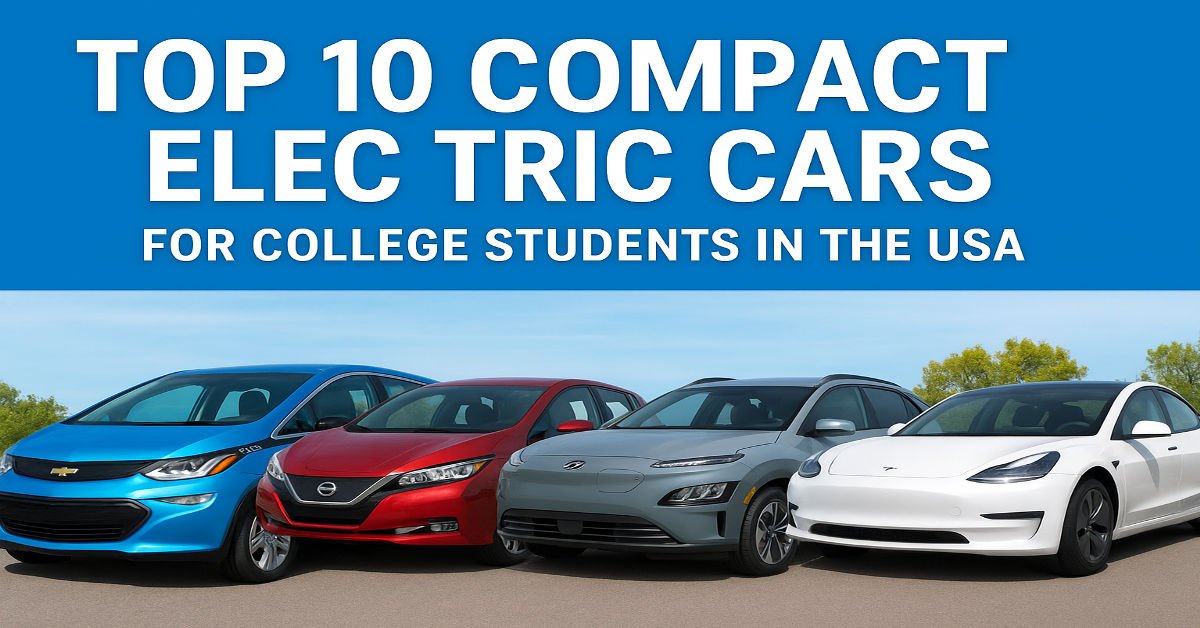
Compact EV Cars for College Students in the USA continue to dominate the U.S. automotive market, many college students are now exploring compact EV options that fit their budget, lifestyle, and sustainability goals. The shift towards eco-friendly transportation isn’t just a trend—it’s a necessity. With rising fuel costs and increasing awareness about carbon footprints, compact electric cars offer the perfect balance of affordability, efficiency, and modern technology for students.
Compact EVs are easy to park, cost less to maintain, and are ideal for urban or campus environments where short commutes are common. In this article, we explore the top compact EV cars for college students in the USA, considering factors like price, range, features, and maintenance costs.
Why Compact EV Cars Are Ideal for College Students
College students often need a car that is affordable, easy to drive, and energy-efficient. Compact EVs meet these criteria perfectly. Here are some reasons they’re an excellent choice:
-
Budget-Friendly Operation – EVs have fewer moving parts than gas vehicles, leading to lower maintenance costs. Electricity is also cheaper than gasoline.
-
Campus Convenience – Compact cars are easier to maneuver and park in crowded university areas.
-
Eco-Friendly Mobility – Many students are environmentally conscious, and EVs help reduce greenhouse gas emissions.
-
Government Incentives – Federal and state EV tax credits make it easier for students and families to purchase electric vehicles.
-
Technology and Connectivity – Most modern EVs come with features like smartphone integration, GPS, and smart dashboards—perfect for tech-savvy students.
Key Factors to Consider Before Buying an EV
Before choosing an EV, students should evaluate specific criteria that match their academic and financial lifestyle.
| Factor | Description |
|---|---|
| Budget | Determine how much you can spend upfront and per month on payments or leases. |
| Range | Choose an EV with sufficient range for daily commutes, typically 100–250 miles per charge. |
| Charging Access | Check for nearby charging stations on campus or at your apartment. |
| Maintenance & Warranty | EVs generally need less maintenance, but warranties differ by brand. |
| Incentives | Apply for federal tax credits (up to $7,500) and state EV rebates. |
| Size & Storage | Compact EVs should have enough cargo space for books, groceries, and travel bags. |
Top Compact EV Cars for College Students in the USA (2025 Edition)
Let’s explore the best compact electric cars available for college students in the U.S. market in 2025. These models were selected based on affordability, performance, charging convenience, and safety ratings.
1. Chevrolet Bolt EV
The Chevrolet Bolt EV remains one of the most popular electric cars among students because of its affordability and impressive range.
Key Highlights:
-
Price Range: Starting at around $27,000
-
Range: Approximately 259 miles per charge
-
Charging Time: Around 7 hours with a Level 2 charger
-
Cargo Space: 57 cubic feet (rear seats folded)
The Bolt EV’s combination of price, practicality, and technology makes it a top choice for students who need daily transportation with minimal cost.
| Pros | Cons |
|---|---|
| Long driving range for its price | Interior materials feel basic |
| Affordable maintenance | Limited fast-charging network |
| Great infotainment system | Compact rear seating |
2. Nissan Leaf
A pioneer in the EV industry, the Nissan Leaf continues to be a favorite compact EV for budget-conscious buyers.
Key Highlights:
-
Price Range: Around $28,000
-
Range: 150–212 miles (depending on model)
-
Charging Time: 8–10 hours (Level 2)
-
Cargo Space: 30 cubic feet (rear seats folded)
Its smooth drive and reliable performance make it ideal for short trips, commutes, and campus life.
| Pros | Cons |
|---|---|
| Proven reliability | Limited range compared to newer EVs |
| User-friendly technology | Basic interior design |
| Affordable used options | No AWD option |
3. Mini Cooper SE Electric
The Mini Cooper SE offers fun driving dynamics and stylish looks in a compact body—perfect for students who want something sporty and unique.
Key Highlights:
-
Price Range: Around $30,000
-
Range: 114 miles per charge
-
Charging Time: 4 hours (Level 2)
-
Cargo Space: 34 cubic feet (rear seats folded)
Despite its shorter range, it’s perfect for city use or campus commutes where long-distance travel isn’t frequent.
| Pros | Cons |
|---|---|
| Stylish and fun to drive | Limited driving range |
| Compact and easy to park | Small trunk space |
| Premium feel inside | Tight rear seats |
4. Hyundai Kona Electric
The Hyundai Kona Electric combines SUV practicality with compact design, making it a great all-rounder for students.
Key Highlights:
-
Price Range: Starting at $32,000
-
Range: 258 miles per charge
-
Charging Time: About 9 hours (Level 2)
-
Cargo Space: 45.8 cubic feet (rear seats folded)
The Kona Electric also comes with Hyundai’s impressive warranty and advanced safety systems.
| Pros | Cons |
|---|---|
| Long driving range | Slightly higher price |
| Modern safety features | Limited rear visibility |
| Spacious cabin | Small infotainment lag |
5. Tesla Model 3 (Base Model)
For tech-loving students, the Tesla Model 3 delivers cutting-edge technology and the prestige of owning a Tesla—though it’s pricier than other compact EVs.
Key Highlights:
-
Price Range: Around $39,000
-
Range: 272 miles per charge (RWD)
-
Charging Time: 6 hours (Level 2) or 25–30 min (Supercharger)
-
Cargo Space: 60 cubic feet (front and rear combined)
Tesla’s charging network and performance make it an excellent long-term investment.
| Pros | Cons |
|---|---|
| Access to Tesla Supercharger network | Expensive for students |
| Outstanding performance | Higher insurance cost |
| Over-the-air updates | Minimalist interior may not appeal to all |
6. Hyundai Ioniq 5
The Hyundai Ioniq 5 is a futuristic compact EV with a spacious interior and ultra-fast charging.
Key Highlights:
-
Price Range: Around $41,000
-
Range: 220–303 miles (depending on variant)
-
Charging Time: 18 minutes (10–80% fast charge)
-
Cargo Space: 59 cubic feet (rear seats folded)
Though a bit above the student budget, its long-term benefits and tech make it appealing for graduate students.
| Pros | Cons |
|---|---|
| Excellent range and design | Higher initial cost |
| Fast charging | Limited availability |
| High-tech interior | Not ideal for tight budgets |
7. Fiat 500e (2025 Model)
The Fiat 500e returns to the U.S. market with a compact design and European flair, tailored for urban drivers.
Key Highlights:
-
Price Range: Expected around $27,500
-
Range: 149 miles per charge
-
Charging Time: 4 hours (Level 2)
-
Cargo Space: 32 cubic feet (rear seats folded)
It’s one of the smallest EVs available, ideal for city campuses like New York or San Francisco.
| Pros | Cons |
|---|---|
| Extremely compact and stylish | Limited range |
| Great for city driving | Small rear seats |
| Affordable entry-level EV | Minimal cargo space |
8. Kia Niro EV
The Kia Niro EV offers a balance of affordability and practicality, making it suitable for both students and young professionals.
Key Highlights:
-
Price Range: Around $39,500
-
Range: 253 miles per charge
-
Charging Time: 9 hours (Level 2)
-
Cargo Space: 53 cubic feet (rear seats folded)
Kia’s reputation for quality and warranty coverage adds to the car’s appeal.
| Pros | Cons |
|---|---|
| Great warranty coverage | Slightly higher cost |
| Long range | Conservative styling |
| Spacious and comfortable | Slower charging speed |
9. Toyota bZ4X
Toyota’s first all-electric compact crossover, the bZ4X, is reliable, safe, and student-friendly.
Key Highlights:
-
Price Range: Around $38,000
-
Range: 252 miles per charge
-
Charging Time: 9 hours (Level 2)
-
Cargo Space: 56 cubic feet (rear seats folded)
It’s a practical EV with Toyota’s trusted reliability and a spacious design.
| Pros | Cons |
|---|---|
| Dependable brand reputation | Moderate charging speed |
| Comfortable ride quality | Slightly bulky for tight spaces |
| Solid safety features | Costly higher trims |
10. Volkswagen ID.4
The Volkswagen ID.4 combines a modern design with impressive range and practicality.
Key Highlights:
-
Price Range: Starting at $39,000
-
Range: 209–275 miles (depending on model)
-
Charging Time: 7.5 hours (Level 2)
-
Cargo Space: 64 cubic feet (rear seats folded)
It’s ideal for students who need extra room for road trips or group projects.
| Pros | Cons |
|---|---|
| Excellent range | Software can be slow |
| Spacious interior | Higher base price |
| Smooth driving experience | Weight affects acceleration |
Comparison Table: Best Compact EVs for Students (2025)
| Model | Starting Price (USD) | Range (Miles) | Charging Time (Level 2) | Cargo Space (cu.ft) |
|---|---|---|---|---|
| Chevrolet Bolt EV | $27,000 | 259 | 7 hrs | 57 |
| Nissan Leaf | $28,000 | 150–212 | 8–10 hrs | 30 |
| Mini Cooper SE | $30,000 | 114 | 4 hrs | 34 |
| Hyundai Kona Electric | $32,000 | 258 | 9 hrs | 45.8 |
| Tesla Model 3 | $39,000 | 272 | 6 hrs | 60 |
| Hyundai Ioniq 5 | $41,000 | 220–303 | 18 min (fast) | 59 |
| Fiat 500e | $27,500 | 149 | 4 hrs | 32 |
| Kia Niro EV | $39,500 | 253 | 9 hrs | 53 |
| Toyota bZ4X | $38,000 | 252 | 9 hrs | 56 |
| Volkswagen ID.4 | $39,000 | 209–275 | 7.5 hrs | 64 |
Charging Options for Students
Access to charging is crucial for EV owners, especially college students who might live in dorms or apartments. Many U.S. universities are expanding their charging infrastructure.
| Charging Type | Charging Speed | Use Case |
|---|---|---|
| Level 1 (120V) | Adds 2–5 miles/hour | Plug into a regular outlet—ideal for overnight dorm charging |
| Level 2 (240V) | Adds 10–30 miles/hour | Most public and campus chargers use this type |
| DC Fast Charging | 80% in 30 minutes | Found along highways and in major cities for quick recharges |
Tip: Students can use apps like PlugShare, ChargePoint, and Electrify America to find nearby chargers.
How to Save Money as a Student EV Owner
-
Apply for Tax Credits: The federal EV credit offers up to $7,500 for eligible models.
-
Use Campus Charging Stations: Many colleges provide free or discounted EV charging.
-
Consider Used EVs: Certified pre-owned EVs offer great value and reduced depreciation.
-
Leasing Options: Some brands offer low monthly lease rates for students.
-
Insurance Discounts: Many insurers now offer lower premiums for EV drivers due to safety features.
Environmental Benefits of Compact EVs
Driving an EV is not only cost-effective—it also supports a sustainable future. Compact EVs produce zero tailpipe emissions, significantly reducing air pollution near campuses and urban centers. Additionally, as renewable energy sources like solar and wind expand, charging your EV becomes even greener.
| Benefit | Impact |
|---|---|
| Reduced Emissions | No CO₂ or NOₓ tailpipe emissions |
| Energy Efficiency | Converts 80–90% of battery power into movement |
| Noise Reduction | Quieter operation in campus environments |
| Renewable Integration | Compatible with solar charging systems |
Future of Compact EVs in the U.S.
By 2030, it’s expected that most American campuses will feature dedicated EV zones and charging hubs. Manufacturers are also focusing on making smaller, more affordable EVs tailored to student needs. With the rise of battery recycling and solid-state battery technology, future EVs will be even cheaper, lighter, and longer-lasting.
Expert Recommendation
For students prioritizing budget and range, the Chevrolet Bolt EV and Hyundai Kona Electric stand out.
If technology and style are more important, the Tesla Model 3 or Mini Cooper SE are solid choices.
Those seeking eco-friendly commuting with SUV practicality can consider the Kia Niro EV or Volkswagen ID.4.
Conclusion
Compact EV cars are reshaping how college students in the USA commute—offering a smart, sustainable, and affordable transportation solution. With a variety of models available under $40,000, owning an EV has never been more accessible. Whether you’re zipping across campus, commuting to an internship, or embarking on a weekend road trip, compact EVs provide the perfect blend of practicality, style, and eco-conscious living.
2 thoughts on “Compact EV Cars for College Students in the USA”