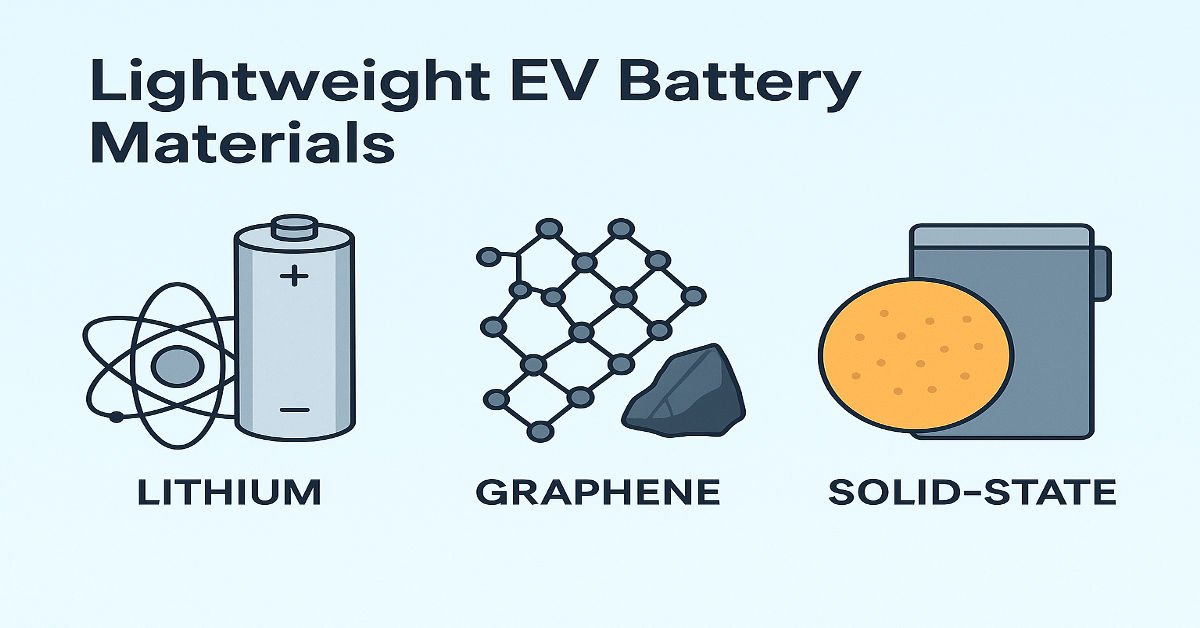
Electric vehicles (EVs) are rapidly evolving, and one of the biggest breakthroughs shaping the industry is the development of lightweight battery materials. As car manufacturers aim to enhance driving range, ensure safety, and reduce costs, innovations in battery chemistry have become more important than ever. Lightweight EV battery materials are now becoming the backbone of next-gen electric mobility.
In this article, we explore the most promising materials, their benefits, applications, and how they support sustainable and efficient EV development.
Why Lightweight Materials Matter in EV Batteries
EV batteries contribute up to 30–40% of a vehicle’s overall weight. Reducing this weight directly improves:
-
Driving range
-
Acceleration and performance
-
Charging efficiency
-
Energy conservation
-
Vehicle safety
This makes lightweight materials crucial for the future of EV innovation.
Key Lightweight Materials Used in EV Batteries
Below are the most widely researched and applied lightweight materials in modern EV batteries:
1. Lithium — the Foundation of Light EV Batteries
Lithium is the world’s lightest metal and forms the core of Lithium-Ion (Li-ion) and Lithium Iron Phosphate (LFP) batteries.
Its natural properties make it ideal for energy-dense and lightweight designs.
Benefits of Lithium:
-
High energy density
-
Fast charging capability
-
Long lifecycle
-
Lightweight composition
2. Graphene — The Next Super Material
Graphene is gaining attention as a revolutionary material due to its ultra-lightweight and 200x stronger-than-steel structure.
In EVs, graphene can significantly improve battery thermal stability and charging speed.
Key Advantages:
-
Improved conductivity
-
Reduced battery weight
-
Faster charge/discharge rates
3. Silicon Anodes — Replacing Heavy Graphite
Traditional batteries use graphite anodes, which add weight and limit capacity. Silicon anodes can store up to 10x more energy, while also being lighter.
However, silicon expansion during charging remains a challenge, which researchers are rapidly overcoming using nanostructures.
4. Solid-State Electrolytes
Solid-state batteries replace heavy liquid electrolytes with lightweight solid materials such as:
-
Ceramic
-
Sulfides
-
Polymers
These batteries offer higher safety and better performance with reduced overall weight.
5. Aluminum-Air and Magnesium-Air Materials
Aluminum and magnesium are extremely lightweight metals.
Air-metal batteries can deliver very high energy density while remaining cost-efficient.
Comparison Table: Lightweight EV Battery Materials
Below is a simple comparison inside a table to help readers understand differences:
| Material | Weight Level | Energy Density | Cost | Current Usage in EVs |
|---|---|---|---|---|
| Lithium | Very Light | High | Medium | Mainstream |
| Graphene | Ultra Light | Very High | High | Experimental/ Emerging |
| Silicon | Light | Very High | Medium | Growing Adoption |
| Solid-State | Light | High | High | Future Technology |
| Aluminum/Magnesium | Very Light | Medium–High | Low | Concept/Prototype |
How Lightweight Materials Improve EV Performance
Improving Range
Light materials reduce total vehicle weight, allowing EVs to travel more miles per charge.
Faster Charging
Materials like graphene facilitate quicker energy flow, reducing charging time significantly.
Lower Cost Over Time
While some materials are expensive initially, they decrease long-term manufacturing and maintenance costs.
Enhanced Safety
Solid-state electrolytes are far safer than flammable liquid-based options.
Challenges in Lightweight EV Battery Development
Despite rapid progress, some challenges include:
-
High cost of advanced materials like graphene
-
Production scalability
-
Heat management in high-density cells
-
Recycling and environmental impact
Ongoing research continues to address these limitations.
Future Outlook: The Road to Ultra-Light EV Batteries
The future of EV mobility is clearly moving toward lightweight, compact, and ultra-efficient battery systems. Technologies such as graphene batteries, solid-state cells, and silicon nano-anodes will soon redefine EV performance standards.
As more countries adopt clean energy policies, lightweight EV battery materials will play a central role in mass EV adoption.
Conclusion
Lightweight EV battery materials are driving major advancements in electric mobility. From lithium to graphene, each innovation contributes to improving range, safety, and overall vehicle efficiency. As research scales globally, we can expect next-generation EVs to be more powerful, environmentally friendly, and cost-effective.
Heard some buzz about mvp77onlinecasino, so I checked it out. It’s alright, nothing mind-blowing but definitely serviceable. The bonuses are okay, and I had a relatively smooth time. Have a peek: mvp77onlinecasino